
Ghost Towns are the ultimate haikyo experience. If you long to be Indiana Jones, this is where you need to go. This is where the mystery is, whole towns that died.
In the doctor’s office the scalpels are laid out for surgery. Battered wooden apartments are still filled with the weathered remnants of their old occupants. Doors hang open, plates sit with rotten food, left as they were.
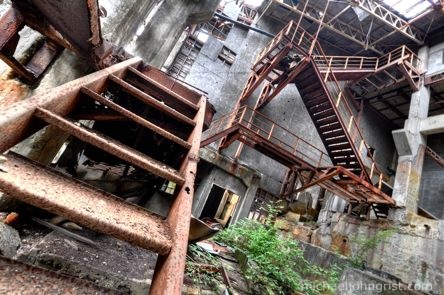
Taro Great Machine Hall |
Osarizawa Chemical Pools |
 |
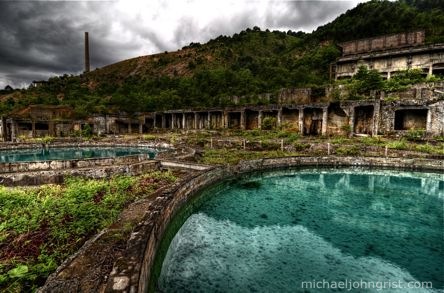 |
| The derelict Taro mine lies at a generational crossing point- once a place where raw sulfides were dug from the earth, now it functions as a cosmic ray laboratory for a nearby University, capturing electrons from outer space in several large heavily wired pools. | Mining of gold and copper at the legendary Osarizawa mine began around 1330 years ago, with the last of the smelting facilities closing down in 1978. Now the site is owned by Mitsubishi, who run guided tours around the highlights. |
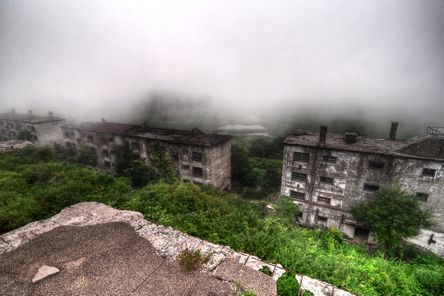
Matsuo Apartment Blocks
|
Seigoshi Mine |
 |
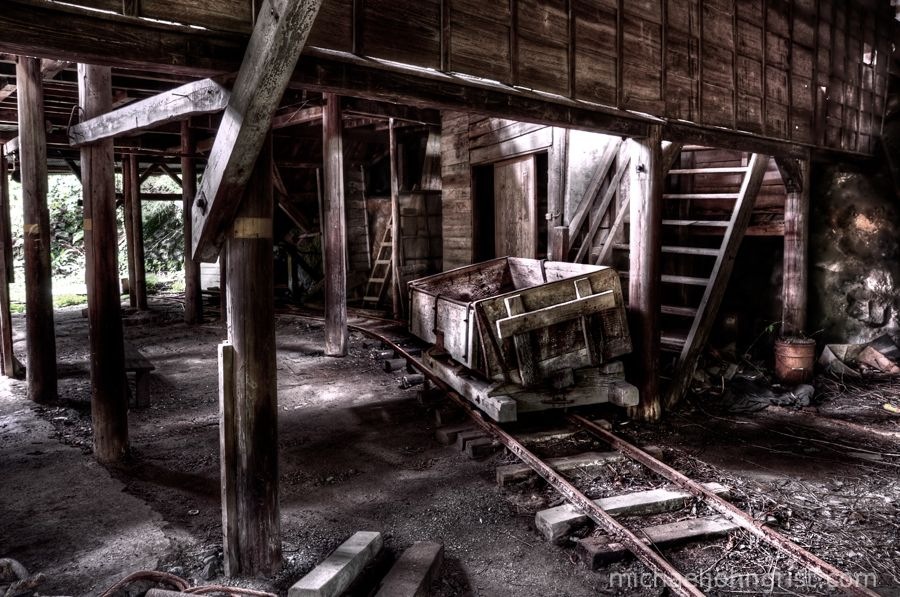 |
| Matsuo mine in the north of Japan opened in 1914 and closed in 1969. In its heyday it was the biggest mine for sulfur in the Eastern world, with a population of 15,000 accomodated in a make-shift city in the mountains of Hachimantai park. | Seigoshi mine hides its secrets well. Fronted by a live builder’s yard, shielded by a fence with a live antenna inside, overgrown, ramshackle, and falling down- if you can plough through all of that you get to the good stuff- lonely mine carts, ancient bottles of whiskey etc… |
Nichitsu 1. Junior High School |
Nichitsu 2. Lower School |
|
|
|
| The abandoned Nichitsu Mining Town sits cramped into a narrow valley at the head of a long and buckled road in the mountainous western edge of Saitama. It was once a thriving company town with hundreds of families. | At the dead-end of a blast-hewn road snaking up through the canyons of North-East Saitama, the Nichitsu mine ghost town lies in wait, wreathed in a low mist and perennially dusk-lit by the overhanging crags. |
Nichitsu 3. Town and Environs |
Nichitsu 4. Doctor’s Office |
|
|
|
| Nichitsu Ghost Town stretches dead and decaying for over a kilometer along its switch-backed mountain road, spreading from barely-functioning mine shacks to the Lower School, dorm, and warren of walkways, all still and silent but for the steady low gnawing of nature. | Nichitsu is a tiny little village huddled in a chilly mountain pass, far from the nearest population center. Come an emergency the Doctor’s office would have been the only ER, so its few rooms were crammed full of equipment, now forgotten and lying in shadow. |
Ashiodozan Ghost Town |
|
|
|
|
| Ashiodozan Mining Town in the mountains of Tochigi Prefecture is infamous for its extreme environmental damage- so much so the factory and mines were abandoned 40 years ago, and virtually all of the people left. | |
|
|
|


