
PAGE 2.
Japan’s ruins (haikyo) show us one possible future, and glimpses of a past we all share.
Abandoned military bases and air fields tell the Japanese story of World War 2, one of defeat and occupation, followed by a stunning renewal and rapid race to industrialize. Ghostly mining towns and factories spell out the consequences of burgeoning globalization in a world of limited resources. Hundreds of dilapidated hotels, theme parks, and resorts preach warnings about the fickle might of the economy to burst the Bubbles it blows itself into.
Volcano Museum 1. First | Volcano Museum 2. History |
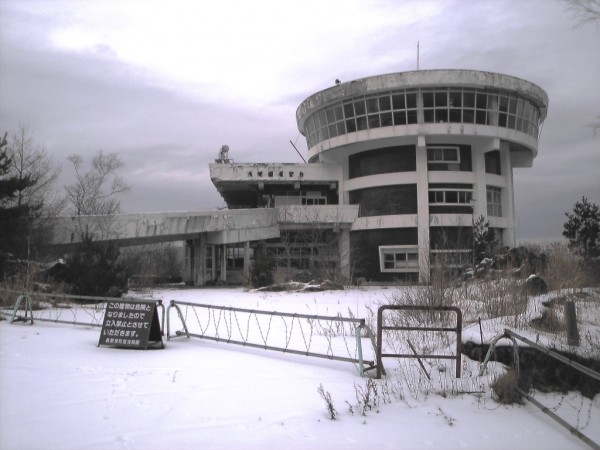 |  |
| Up in the mountainous north-west corner of snowy Gunma prefecture, at the foot of the once-active volcano Mt. Asama, lies a beautifully weathered abandoned volcano museum. Ruptured by avalanche scree and scoured by the harsh winter winds rushing down the valley, it stands as a lone sentinel guarding the jagged granite slopes leading up to the volcano’s cone. | The Mt. Asama Volcano Museum was a mould-breaking facility opened in 1967, offering insight into the life-cycle of the most active volcano in Honshu, and into the area of volcanic rock surrounding it known as Oni Oshi Dashi. Its opening ceremony was attended by then-Crown Prince Akihito and his young wife Crown Princess Michiko. |
Volcano Museum 3. HDR | Volcano Museum 4. Wedding |
 |  |
| This was my second time to go to the Asama Volcano Museum. The first was on my first haikyo road trip back in 2007- back when I was packing only a cameraphone to shoot with and cared far more about the explore than I did about the photography. | Dom and Liduina dress up in their wedding clothes and show us how to really shoot a haikyo. And Edmund wears an anime mask. My first haikyo model-shoot, and an excellent experience in all. |
Volcano Museum 5. Documentary | Nara Dreamland Heyday |
 |  |
| Well over a year ago now a Belgian film-maker called Jeroen Van der Stock got in touch with me about making a haikyo / ruins documentary in Japan. | Even now many thousands are still entranced by Dreamland abandoned, and a few have provided photos of this Disneyland homage in its heyday. |
Bones of a Gunma Ski Lift | Abandoned Hume Cement Plant |
 |  |
| The Gunma ski lift was the glace cherry on a sumptuous cake of weekend haikyo. We’d headed up into the northernmost quadrant of Gunma seeking a mine/factory. The mine itself turned out to be not all I’d hoped for, mostly demolished and overgrown, but the ski lift and adjoining recently abandoned ski resort were a wonderful consolation prize. | It was the third time for me to set out in search of the Hume factory. The first time was on our inaugural haikyo road trip, the second time was solo. This time it was first on our list, and stood no chance of escaping exploration. |
White Root Mine | Derelict Hilltop Shrine |
 |  |
| The White Root mine is old, so old that only the faintest outlines of its bones remain. Squint hard and you might see fragments of its ribcage scattered over the hillside, parts of a cracked skull just visible through the topsoil. | Japan is riddled with shrines, both in cities and out in the countryside, huddled in the basin of wintry valleys or perched precariously on top of mountains- often at points of raw natural beauty and power. From time to time though these wooden complexes go bankrupt. |
Peaceful Gunma Motor Lodge | Tokyo’s lonesome haikyo bridge |
 |  |
| I don’t know anything about this haikyo- no history, no past claims to glory or modern haunting. Like the Sun Hills Hotel Car Park before it it’s just a place with some beautiful shapes, light, and decay. Nobody goes there, though access is easy. | Months ago now I ventured out on a slow work day to meet fellow haikyoist and photographer Adrian Tan. He suggested going to shoot a haikyo bridge, and my curiosity was definitely piqued. |
Keishin Hospital 1. First Visit | Keishin Hospital 2. HDR |
 |  |
| The gutted shell of the abandoned Keishin Hospital stands blank and ghostly on the rural Kanagawa sky-line. It once housed state-of-the-art radiology and cancer departments, now the only pieces of equipment remaining are the chairs bolted to the floor in the dentist’s office. | Keishin Hospital was once a pre-eminent site of super high-tech radiology equipment, leading the charge as Japan raced into the modern era. Some 2o years ago that dream fell by the way-side though, and the place was left to the vandals. They tore out everything that could be torn out, leaving only a few metal fixtures too heavily stapled down. |
Keishin Hospital 3. Graffiti | Keishin Hospital 4. Model |
 |  |
| Often ruins have a few tags littering their walls, messages and names left by some dumb-asses in their bid for eternal glory. Scrawls, defacements, junk. Well, not so the Kesihin hospital. It is a gallery of gorgeous, skilled, vivid art that Banksy would be proud of. | After the grand luck of Dom and Liduina contacting me for a wedding haikyo shoot a few months back, I figured I couldn`t bank on the same thing happening again. If I wanted to shoot models in haikyo more, I`d have to get out there and find them myself. |
Toyo Bowl 1. First | Toyo Bowl 2. HDR |
 |  |
| The Toyo Bowl in Kanagawa was a mammoth venture when first dreamed up, the second biggest bowling alley in the world behind the Nagoya Toyo Bowl, featuring 108 bowling lanes spread over 3 huge floors, along with a large pachinko hall, restaurants, gift shops, arcades, and a creche. | The Kanagawa Toyo Bowl was one of several 1980’s alleys built during Japan’s bowling ‘boom’, coinciding with the years of the economic Bubble. When the Bubble collapsed in the early ’90’s so began the end of the bowling boom, and all of the Toyo alleys across the country eventually went into receivership. |
Forgotten Seminar House | Lonely Seigoshi Mine |
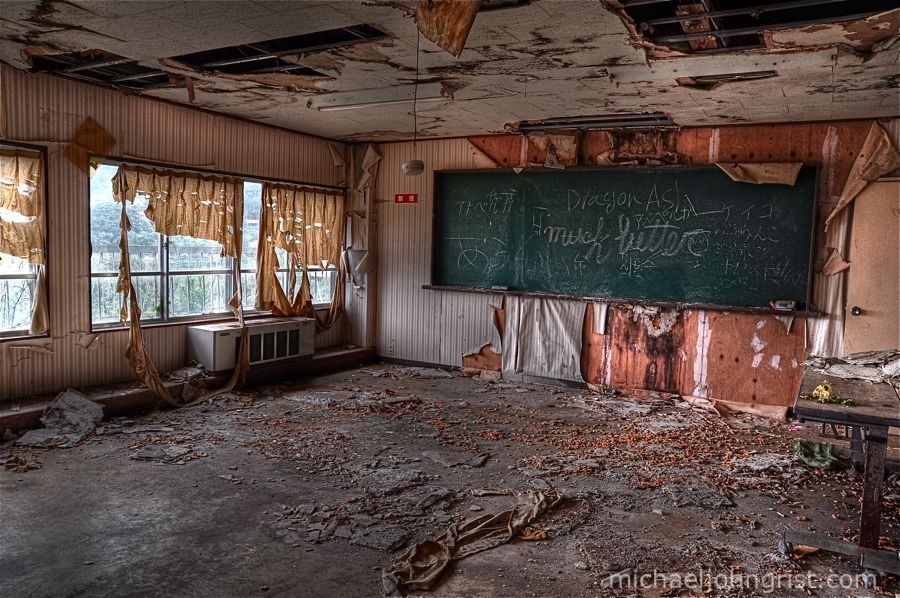 | 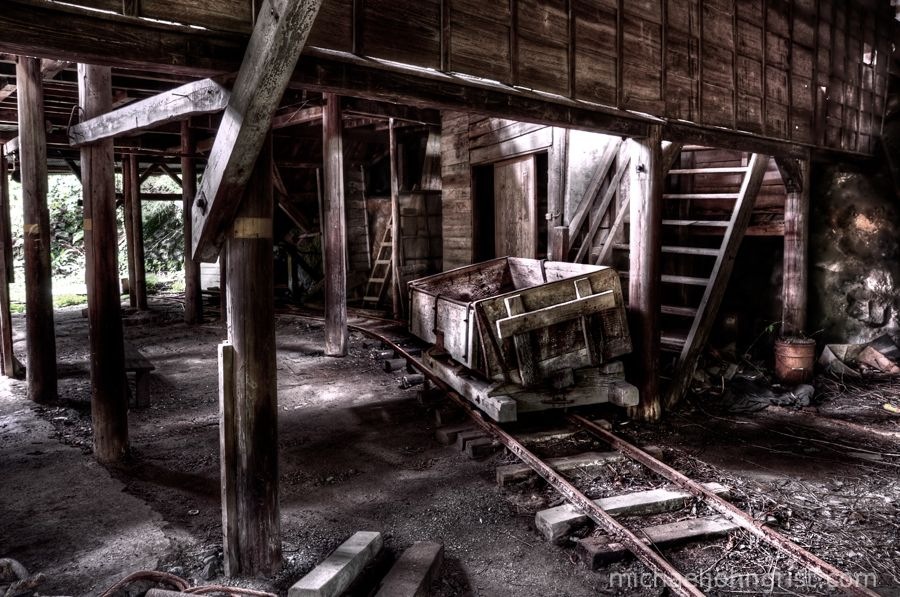 |
| We took the coast route around the hill, trying to find a road that would lead us to the Seminar House Paul had seen from the train. At the top we rolled around wealthy summer homes for 20 or so minutes, peering over the edge, constantly wondering if we were too high, too low, too far round. We got out to walk. “Look, it’s a deer.” | Seigoshi mine hides its secrets well. Fronted by a live builder’s yard, shielded by a fence with a live antenna inside, overgrown, ramshackle, and falling down- if you can plough through all of that you get to the good stuff- lonely mine carts, ancient bottles of whiskey, LOST-like hatches complete with beeping machinery, and store rooms filled with boxes of TNT. |
Tohoku Ghost Towns 1. Matsuo | Tohoku Ghost Towns 2. Taro |
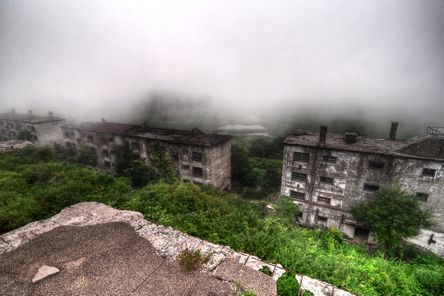 | 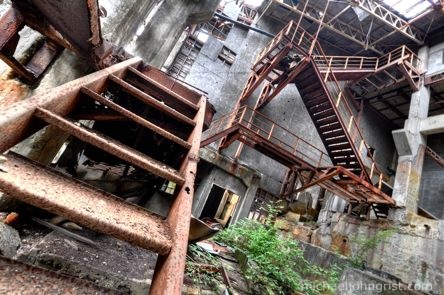 |
| Matsuo mine in the north of Japan opened in 1914 and closed in 1969. In its heyday it was the biggest mine for sulfur in the Eastern world. It had a workforce of 4,000 and a wider population of 15,000, all of whom were accomodated in a make-shift city in the mountains of Hachimantai park. The city was known as the ‘paradise above the clouds’. | The derelict Taro mine lies at a generational crossing point- once a place where raw sulfides were dug from the earth, now it functions as a cosmic ray laboratory for a nearby University, capturing electrons from outer space in several large heavily wired pools. It was the first of four mines on our Iwate shopping list, ranked number 3 in all of East Japan. |
Tohoku Ghost Towns 3. Kamaishi | Tohoku Ghost Towns 4. Osarizawa |
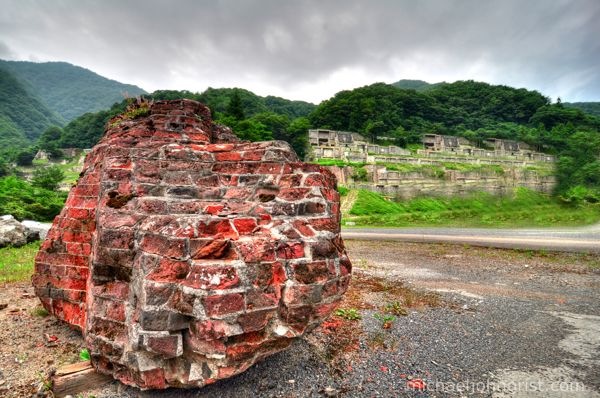 | 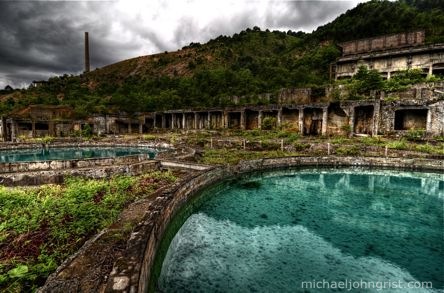 |
| Kamaishi Mine is ranked as the second best haikyo (ruin) in all of east Japan, according to one of the haikyo books I follow. Iron has been mined there since 1727, and Japan’s first blast furnace was built there in 1857. Production peaked in the 1970’s, with more than a million tons of ore coming out a year. | Mining of gold and copper at the legendary Osarizawa mine began around 1380 years ago, with the last of the smelting facilities closing down in 1978. Now the site is owned by Mitsubishi, who run guided tours around the highlights and a museum for 1,000 yen- a tour we almost got chain-ganged into joining. |
Okawa Grand Hotel | Small Pox Isolation Ward |
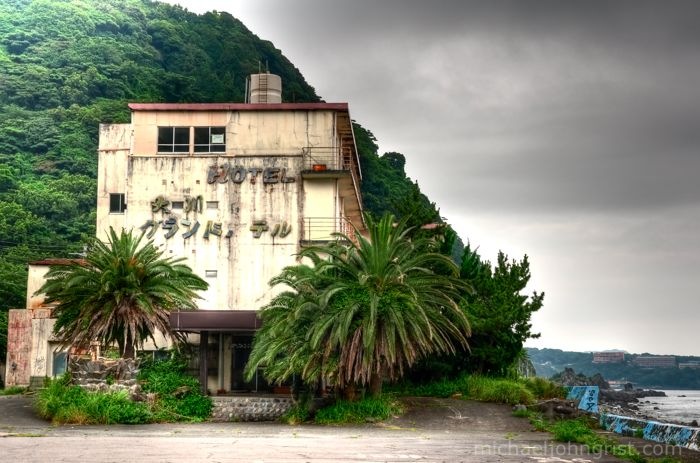 | 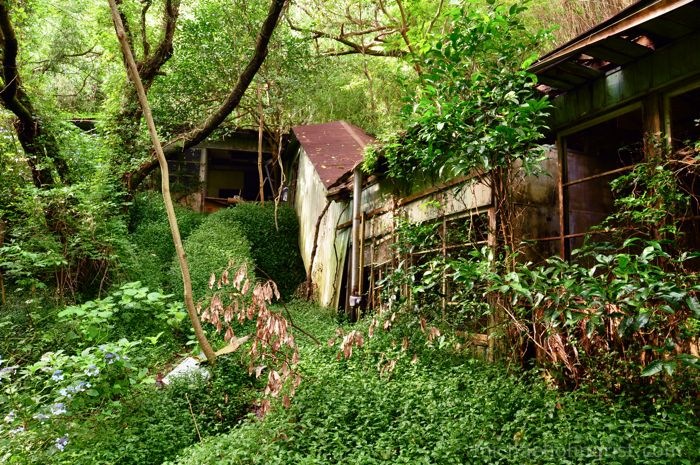 |
| The Okawa Grand Hotel in Izu was remarkable for the perfectly clean, skimmed and filtered swimming pool set between its two tropically ruined buildings. Shut down for at least twenty years but still plastered with signs to rent or sell, the owners clearly still have high hopes for it. In every room you can hear the lapping of the sea on the rocky beach. As we left, a gang of kids moved in to use the pool. | Small Pox was once an incurable killer, claiming around 380 million deaths in the first half of the 20th century before its eradication. The people who contracted it were likely to die, and had to be removed from the general population lest they spread the infection to others. The Small Pox Isolation Ward Haikyo set into a then-remote Izu cliff-side was one such place they’d be banished to. |
Heian Wedding Hall | Akeno Gekijo Strip Club |
 | 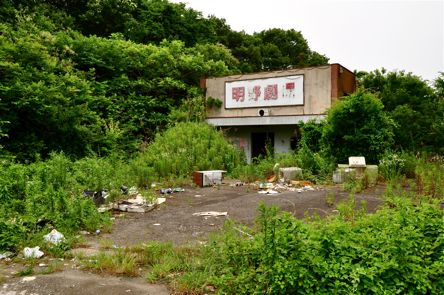 |
| The ruined Heian Wedding Hall in Ibaraki prefecture was a far cry from the Akeno Gekijo Strip Club that preceded it. Here was a wholly wholesome building, built for the profession and binding of love’s vows, decorated in the most tasteful manner with Adam and Eve mounted on winged steeds in stained-glass friezes. | The Akeno Gekijo haikyo is something of an oddity in Japan, as the only actual strip club I’ve seen here. Of course there are similar venues; hostess bars, soaplands, love hotels, but they each cater to a slightly different crowd and provide a slightly different flavor of tawdry service. To find a straight-up strip club complete with central podium, viewing seats, and dancing poles seems a feat beyond expectation. |
Click through to see the old curiosity shop, still more haunting ghost towns, and the behind the scenes ruins of a cablecar ropeway, amongst many others.
Page 1 | Page 2 | Page 3 | Page 4 | Page 5 |
Comments 12
What a sadly awesome page. “Ozymandius East”.
Great shots! I’d love to visit places like those, it looks amazing, yet quite frightening! How do you find them?
Author
David- Thanks, that’s a great title. Maybe I’ll borrow?
Val- Thanks so much, about half come from a book I have, and the other half from various tip-offs or random finds of my own. Only really frightening when I’ve gone solo, and at night. With friends it’s more just like fun.
Hello Michael,
I don’t know whether you’ll be having a look at this, but I simply wanted to thank you for this awesome website which have caught my interest for the past 2 days 🙂
Your haikyo pictures and articles are captivating and I started having a look at your writings as well.
I should be moving to Japan in January, and feel truly excited that I might be visiting such places. My interest in ruins started as a child. Fairly close to my house (in France) was an old psychiatric complex that, I realize know, was the ideal haikyo. The old building was fairly unstable but the newer one was amazing : big windows, furniture and medical equipment… This place was the absolute nightmare of my childhood and it took me 15 years to get inside, just before they demolished it!
Anyways, all this to say thank you for your amazing work 🙂
Cheers
Hello:
I think you used to have a link to my site, previously urbex.mikeonline.ca. I would like to have such an exchange again. Your site is currently listed on my site, which has changed to http://urbexobsession.com.
Thanks for your time.
Hi, could I use this picture: http://www.michaeljohngrist.com/wp-content/uploads/2009/08/sherman-tank-off-garapan-beach-saipan-90021.jpg for my article? Of course with a proper attribution and a link to your website.
Hi there, I really love your photos from the Nara Dreamland. I’m headed to Osaka at the end of the month, would you be kind enough to suggest “haikyos” (I learnt this word here!) that I could check out around the region? I’m looking forward to head to Nara Dreamland.
Hi MJG
One of my all-time favourite movies is Sen to Chihiro no Kamikakushi, so reading your blogpost about ruins in Japan has probably been the most exciting thing I will be doing this Christmas! 🙂 Hope you are still exploring and sharing – I see this post is nearly a decade old now.
Take care.
R
I was trying to find information about the old Yawata Steel Works and the old Space World Amusement Park in Kyushu, to see if I could sneak in and photograph, then I found your site. What really grabbed me was the piece on Camp Drake, my first assignment in the Air Force. So, anyway, thanks for the memories and keeping this site up.
Love lov e love this site
Sir I would like to use the following photo of yours on my site an one of the Tachikawa AB pages Tachikawa
Air Force Base re claimed by nature, Tachikawa Air Force Base Haikyo11 and Tachikawa Air Force Base Haikyo24.
Thank you
I was stationed at Fuchu AB 1966-1969 and my first daughter was born in Tachi Hospital.
We had a small car (as did everyone else) and went to Yakota Base for less expensive shopping than Fuchu, thanks to the Fuchu PX run by the base commanders’ wife…too rich for an Airman’s salary.
Tremendous memories from our time in Japan.